
I thought that during this little break I would talk a bit more about the sources that enable the History of the Hungarians to even exist. The first one of these had to be Anonymous, for reasons that shall become obvious after today.
His name is not known – hence the moniker – as he only refers to himself as either Bele Regis Notarius, meaning the Notary of King Béla, or as Master P. This latter bit could even mean Prae Dictus Magister, which would assume that his name was lost during the process of copying his work. The way the work itself is structured makes it likely that Anonymous studied abroad, in Western Europe – likely as far as Paris –, and read multiple similar works there, like the Historia Regum Brittanniae.
He writes his work after the death of his master, King Béla III, in the early years of the 13th century, and his goal is to uncover the origins of the Hungarians. Because of this, he goes back as far as the Conquest, and even before it, spinning a narrative about heroes and the predestined conquest of the Carpathian Basin.
His Gesta Hungarorum was, for the longest time, the only real written source we had of the Conquest and that period. Sadly, however, later examination have shown that his work is riddled with a certain way of working backwards from his starting point: namely his own era of the early 1200s. This era was marked by the growing power and influence of the nobility, and their desire to maintain their ancient privileges against the royal power. In Anonymous’ work, these noble families descend from the chiefs and heroes of the Conquest, and held the same rights and privileges as the royal line did. He makes up the heroes and the villains of his story wholesale, which is a bit of a problem, given that he has very little to no knowledge about the real forces at work in the Carpathian Basin during the period, leading to misunderstandings, especially about areas he did not know much about, like Transylvania. He also gives an inaccurate account of the way the Conquest-era warfare worked.
What he does have is a detailed knowledge of certain geographic areas within the Carpathian Basin.
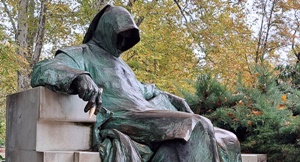
Nowadays, you can see the statue on the picture if you are in Budapest, walking in the Városliget, around Vajdahunyad Castle. Touching his robe is said to bring good fortune to writers.
(Picture taken by Yours Truly)