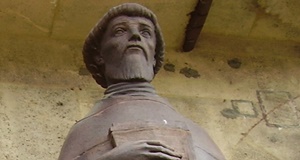

This week will see the continuation of our small little series on the sources of Hungarian history, with discussing another writer, Simon of Kéza.
Simon wrote his work in the latter decades of the 13th century, and specifically mentions László IV as his inspiration. His exact origins are unknown, and there are many theories about it, ranging from him being a commoner up to the lower strata of the nobility. But whatever it was, he is remarkable for two specific reasons: he is almost certainly a Hungarian by origin, and he is the first Hungarian historian whose name we actually know. The earlier Master P, after all, is better known as Anonymous. While multiple theories exist about his place of birth, we can be fairly certain of his Hungarian origins, as he keeps referring to the Hungarian language as “our language”.
His work bears the unfortunate title of Gesta Hungarorum, the same as that of Anonymous, but to get around this fact, Simon’s work is most often referred to as “Gesta Hunnorum et Hungarorum”, meaning “Of the Deeds of the Huns and the Hungarians.” He begins his tale by recounting a mythical origin of the Huns and Magyars as the tale of two brothers, Hunor and Magor, then follows the Huns from their origins up to the death of Attila. The second book of his work follows the Magyars, from their Conquest of the Carpathian basin up until the 1270s.
He travels to Italy, France and Germany, and is familiar with their own chronicles. These visits might be one of the major sources of the Hunnic-Magyar relation, which is so strongly there is Simon’s work. While Anonymous restricts himself to the equation of the Hunnic and Magyar dynasties, Simon goes much further, drawing a familial relationship between not just the very top of the elite, but the peoples of the empires themselves.
All this means that, in his desire to include both the societal elite and the royal line in his work, and satisfy both of these groups, Simon of Kéza is more or less responsible for the idea of the Hunnic origin we discussed in our very first episode. His idea about the free elite, descended from the Hunnic nobility is so powerful, and puts down such deep roots in the 13th century that it remains more or less an unquestioned assertion until the 19th.
Next week the show will be back in full force as we dive into the era of the Árpádian Dynasty.