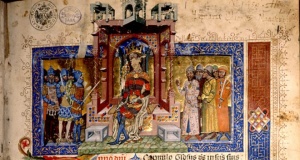

I thought I would try to resurrect this little segment of mine, and continue the discussion on the sources of the show. This week, we shall dive into the matter of the Illuminated Chronicle.
We immediately run into a bit of an issue regarding the authorship: there is a debate whether the author was Hungarian or not. On one hand, when the Illuminated Chronicle was translated back to Hungarian from its original Latin, its translator noted that they were working with a Latin script that was specifically used with Hungarian grammatical solutions in mind. However, many Hungarian locations are written in strange manner, or even in contradictory ones, one way here, another there. The solution to this problem is that the author of the chronicle was likely working from an assortment of other Latin texts, and remained faithful to them, even as he was describing various locations around the kingdom.
Another aspect of the Illuminated Chronicle are the 147 icon-sized illustrations – a treasure-trove of medieval artworks, and a unique collection to boot. These were most certainly created by a Hungarian illustrator, as they contain jokes and folksy saying that are only really understandable in the Hungarian language.
Its creation is datable to around 1360, and came to be for a very specific reason. By this point, the Árpádian Dynasty, the subject of our current season, was gone, and replaced by the House of Anjou – a dynasty of French origins, but its Neapolitan branch. This made it so that the young heir to the throne, Lajos – or Louis – was not as integrated into the culture of his subjects as many other rulers before him were. The chronicle was created for him, so that he would learn about the history of his lands, the people he was to rule, and the men who held the title before him. This also means that the chronicle is our first source that is completely and fully dateable from outside our current period.
The chronicle was still in Hungary a century after Lajos’s reign, then began something of a wild journey. First it was taken to France, then it popped up in Serbia, of all places, before coming to Vienna in the 16th century – giving us the reason why it was also often called the Viennese Illuminated Chronicle. Only during the stormy 20th century would the chronicle return to Hungary, where it remains in the National Széchenyi Library to this very day.